AWDPI|Online-Rewriting Identity: Who Are We After Migration?


feature-image


Migration is often seen as a journey with a clear destination. But in reality, arriving in a new country is only the beginning of another, more complex process — the reconstruction of identity.


In today’s world of increasing mobility, migration is not just about crossing borders. It involves navigating new systems of classification, confronting unfamiliar racial narratives, and renegotiating the meaning of self and belonging.
Once settled in a new society, especially one shaped by histories and racial hierarchies, migrants must ask: Who am I now, and who gets to decide?


About the Talk


This talk explores two key themes:


· Post-migratory identity formation:


Migration does not bring individuals into a neutral space. Rather, they enter a terrain shaped by legal frameworks, racial discourses, and colonial legacies. In this new context, migrants often encounter legal uncertainty (such as unclear immigration status), structural exclusion (e.g., non-recognition of foreign qualifications), and cultural marginalization (being positioned as the “Other”).

Here, post-migration does not simply refer to a moment after resettlement. It describes an ongoing negotiation of identity, power, and belonging. This part of the talk will explore how migrants navigate these constraints:
Can former identities be maintained? What does it mean to re-establish a sense of self within unfamiliar, and often unequal, systems?


1


2

· Re-learning a racialized identity:


Racialized identities are not self-chosen — they are constructed through history, institutions, and everyday social interactions. These identities are often imposed, but they are also sites of resistance and renegotiation.

For many migrants, moving to a new country intensifies these dynamics. Some respond by trying to blend in, minimizing differences in language, behavior, or appearance. Others engage in active resistance through self-definition, community organizing, and collective action.

This session would explore: How do racial stereotypes affect how migrants understand themselves? When society sorts individuals by skin color, accent, or passport, is there still room to redefine oneself — or even reclaim agency over one’s identity?

  • Date & Time: Friday, 27 June 2025, 10:00 AM ( UK Time)

  • Format: Online via Zoom-English (Recordi ng available)

    https://unimelb.zoom.us/j/89520033307?pwd=0yIUBDHXaIfJwWsw1COOlxtA4q3kMo.1

    zoom number: 895 2003 3307
    keywords: 917968


Speaker | Dr. Sreenita Mukherjee

PhD Researcher, Queen Mary University of London

Specialist in Postcolonial Feminism, Identity, and Race-Gender Relations
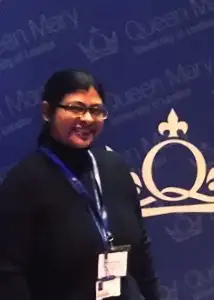
Dr. Sreenita Mukherjee’s work explores how race, gender, and professional identity intersect — particularly for immigrant women architects from former Commonwealth countries living and working in the UK.


Drawing on postcolonial feminist theory, she examines how a traditionally white, male-dominated industry like architecture continues to shape — and often constrain — the experiences and recognition of minority women professionals.

Her research addresses questions such as

  • What personal and professional barriers do immigrant women architects face in the UK?

  • How does the origin of their professional credentials (e.g., earned in former colonies) influence their career trajectories and legitimacy in the British context?

  • In the face of systemic exclusion, how do these women reclaim professional identity and build social and economic resilience?


Dr. Mukherjee’s research offers not only a critical lens on structural inequality, but also practical insights into how institutions and policies might become more inclusive and just.


Scan the code to join the activity group chat. If the QR code is invalid, you can add it through the assistant:



活动负责人|周欣愉

排版/封面|王小涵

图片来源|unDraw